Mobile friendly Google Algorithm update

As most you may know by now and expect the next major Algorithm update to roll out by Google by around the 21st April week.

mobile friendly google test

Let’s take a closer look at what Google’s trying to accomplish by rolling out this update.

This is Google’s much awaited step towards providing primarily mobile friendly sites in mobile search.

The update will impact mobile search results globally in all languages, and Google says it will have a “significant” impact.

To make sure your site is mobile friendly or not on Google’s mobile search results, run your site through the mobile-friendly testing tool. If you get through, you have nothing to worry about.

There are many websites in Sri Lanka that are not Mobile friendly and needs immediate action in order to keep up to speed with Google.

Old School SEO

So, last week I was approached by a prospect (now new client) that had been working with another SEO company to improve their website’s rankings. The strategy they were employing was to purchase multiple keyword loaded domain names and deploy them as landing pages in the hopes of attracting traffic to those pages based on the keywords contained in the URLs. Thus far, the client has never seen any benefit from this whatsoever.

Old School SEO

Now… this was a strategy employed some years ago with fairly high success (at least in terms of attracting eyeballs). However, as I explained to my new client, this strategy is very, very old school. Here’s why…

Begin first of all by thinking about what Google is trying to accomplish through its search rankings. The answer is simple: it wants to provide the best, most satisfying results to the searcher so that the searcher will continue to use Google as their search engine of choice, thereby ensuring its continued dominance of the Internet. Obvious…

Now, ask yourself how Google makes the determination of what searchers are going to like in terms of search results. The answer to this should also be somewhat obvious: really good websites! So, when Google is looking at and figuring out where to rank websites it is essentially analyzing them on the basis of usefulness to the searcher based on the keyword(s) they just searched for.

So, what do you think makes a website valuable to you? Well, obviously a site that reflects the keywords you just searched for in terms of the words on the page, the topic the content is about. But, beyond that, what else? How about videos also tagged with those keywords. Or a blog also full of that sort of content. What about podcasts? Or if it’s a retail site, a well designed and secure shopping cart system, with a secure payment system. What about good, simple navigation? And fast loading pages.

Getting the idea? Right. Google is becoming very sophisticated in its ability to analyze websites. And it is using these sophisticated algorithms to not just look at the text on a page, but also how valuable the site is to a user based on a wide variety of criteria. So, with this in mind, why does anyone think that Google would place high value on a single landing page that’s keyword loaded simply to try to attract search engines? Is there any value there? I think we all know the answer to that.

So… want to be in Google’s good books? Think like Google and start making great websites that people will love.

Top 5 SEO Mistakes

If effective SEO is a concern of yours (and it should be!) there are many things to avoid when building a website, many of which will have a very serious impact on whether someone can ever find your site using a search engine. Some of these are simple fixes, and some not so simple.

Boy… where do I start! There are so many… hmmmm… Here goes, and be advised that these are not in definitive order.

SEO Mistakes

1. Not having sufficient on page content. This is amazingly common. The causes could be a variety of things. Pages built in Flash, text buried in graphics or design that doesn’t allow for the use of many words. But, the effect is the same. Google needs to find the words on the page in order to assign relevance to your website when compiling the search results. While lack of content can potentially be offset through other means, for the most part, you have to show Google and your customers what you are all about. And that means words.

2. Not developing a website with SEO in mind. Jeez, I wish I had a buck for every website owner that came to me for SEO services for their brand new, swanky website after it had already been built with a host of problems. Potential problems are many and varied, from having insufficient text (as in the above), excessive and clunky coding which hampers indexing, excessive java script, or poorly designed pages with high bounce rates, etc. I even saw a site once that was built in such a way that you couldn’t implement H Tags! The truth is, many programmers/developers just don’t know the requirements of the search engines.

3. Inappropriate use of keywords. Keyword selection is really where you separate the wheat from the chaff. It is crucial more now than ever before that you select the keywords that accurately describe you and have the potential to lead to a high conversion rate.

Essentially this is because of two overall factors:

I. the SEO landscape is starting to get pretty crowded out there. Unless you have a super powerful website, it is very difficult to compete for a wide range of keywords. You are better off focusing your energy on those that will give you the best shot at highly targeted traffic.

II. Google is now looking at how effective your site is at retaining search traffic. If you start attracting unfocused visitors who immediately bounce away, Google will start to drop you down the SERPs. Google likes happy searchers… 😉

4. Not devoting enough (or any) attention to linking. As has been the case for a long time now, Google looks at how interconnected you are with a community of similar websites. It uses this to guage how “legitimate” and valuable your site is… figuring that if many similar websites are linking with you, you must be good. Though this has been the case for a long time, it is shocking how many websites devote little attention to this. And, given Google’s recent changes, this is even more important than ever.

5. Lastly, only doing part of the job. Google looks at a huge array of factors when positioning a website in its SERPs. optimisation means looking at as many of these factors as possible, and making the changes required. I’ve seen countless “SEOed” sites that only went part of the way. Good content, but no links… good Page Titles, but no supporting content… matching Titles and content, but crappy keyword selection… and the list goes on. These days, if you only do half a job you may as well kiss your investment goodbye.

So… like I said, these SEO mistakes aren’t in any particular order, but addressing them is crucial to success. Oh yeah… and one more thing: do yourself a favour and consult an expert 😉

Huge increase in direct visits

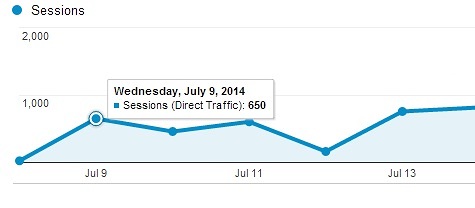
It happened on the 09th of July, suddenly direct visits to one of our websites started spike up to 650 from 25 visits the previous day. This was a very unusual increase in terms of web traffic. Immediately we contacted the client to see if they have had a TV ad or any other offline promotion go live. It turned out to be that they had no offline marketing effort during the last few days.

After a few days the direct traffic started to increase gradually to seven hundred, then eight hundred, then nine hundred and ultimately hit one thousand. Meanwhile the bounce rate of the website started sky rocketing.

Huge increase in Direct visits

Bounce Rate: 99.65%

Avg. Session Duration: 0:02
Pages/session: 1.01
Almosts all new users

We began to investigate the issue and found few others were also impacted by the same issue.

http://moz.com/community/q/huge-spike-in-direct-traffic-from-ie7

http://www.ukbusinessforums.co.uk/threads/huge-increase-in-direct-traffic-to-our-site-in-the-last-four-days-with-a-high-bounce-rate.329389/

Google Analytics Stats

We started to investigate further about the huge increase of direct visits to the website and we saw most of the visits came mainly from the United States & spread across many other countries. Majority of the visits came through IE7 & IE8 browsers.

What was done so far, 

Filtered the traffic from the browser IE7 & IE8 (where most of this fake traffic generated through), from the main reporting view to keep the reports clean.

Then I created a new view called (IE Traffic) to monitor the large volume of direct traffic.

Will monitor the Direct visits until a solution is found.


Get on board

One of the problems with SEO is that few people really understand it, and some may even not appreciate its value. When dealing with complicated projects with sensitive budgets and many hands in the pie, getting everyone on board with the project may be… uh… “challenging”.

Get Onboard SEO

Photo Courtesy of benefitspro.com

The problem with convincing clients and management to use SEO is twofold. First of all you have to convince them that SEO actually works. They have the right to be skeptical when so many people have used complicated SEO jargon to sell their services without providing the results clients expect. Once you convince them that SEO can work, you have to convince them that you are the person who can make it work for them.

How do you do it?

To put it simply do the opposite of the jargon talkers who have burned your clients in the past. Avoid the clever buzzwords and explain briefly why your process works and then show that it works. Instead of talking the talk, make your numbers speak for themselves.

To do this you have to be clear:

Explain what SEO is, because a surprising number of people are unaware

Explain what specific services you can offer

Show them the increase in website traffic and conversions and Google ranking to show how your work has benefited others and then be specific about how it can be benefit them. Once they see how their crawlability can go up with specialized links, controlled relevant content, they will see how SEO can serve as the foundation of their successful online business.

The first part is easy. Everyone uses search engines to surf the net. If you can’t find a website when you search on Google, there isn’t much point to having the website at all. By explaining how SEO increases your search engine ranking, you can easily explain how that can change the utility of a website.

Marketing changes depend on the medium you use. After all you wouldn’t put a colorful illustration in a book for the blind. In the same sense a gigantic billboard would be useless if it was placed in a location where it was obscured by high rise buildings and impossible to see. SEO is like that, only instead of being obscured by features of the landscape, your client’s website can be hidden by ignorance of how the online landscape works. There is a great pile of information on search engines. The question is how can you make your website stick out of the pile? The most important part of any message is that people read it and SEO is the process of securing the proper location for your customers to see your products.

Now explain what makes your company different. Don’t give away your secrets, but let your clients know what you can do for them, and be specific. This same principle applies to dealing with management and the members of your team. Show Google analytics of websites you have worked with, tracking their site views and online sales. Once your team realizes how valuable SEO can be, they can make it an intrinsic part of their own process.

Because in this day and age, SEO shouldn’t be something you add on, it’s a requirement. Buzzwords are the stock and trade of charlatans, a successful SEO business offers results, not catchphrases.